In 1940 Lee Krasner met Jackson Pollock and she has been living under the shadow of ‘Mrs. Pollock’ ever since; her groundbreaking contribution to Abstract American painting severely underestimated. Take for example the Royal Academy exhibition Abstract Expressionism exhibition in 2016, Krasner’s name was not even included in the list of artists that formed the ‘movement’: Pollock, Rothko, Still, de Kooning, Newman, Kline, Smith, Guston and Gorky. Three years later Krasner has finally received the retrospective she deserves: Lee Krasner: Living Colour at the Barbican Centre in London. The first comprehensive survey of her work to be exhibited in Europe for over 50 years. This Saturday I finally had the chance to visit the exhibition.

Mosaic Table (1947) 
Stop and Go (c.1949-50)
The exhibition begins with Krasner’s ‘Little Images’ section. In 1945, after her father’s death, she had only been able to paint ‘gray slabs’, but in the autumn of that same year Krasner and Pollock moved to Springs, near East Hampton, Long Island. In their new house Krasner started to create jewel-like abstractions, layering paint thickly onto the surface using a palette knife and working into it with a stiff paintbrush. By the winter of 1947, with not enough money to heat their entire house, she moved from her upstairs bedroom studio to the downstairs living room. She created mosaic tables from two old wagon wheels using tesserae, costume jewellery, keys, coins and broken glass. This decorative arts technique is echoed her ‘Little Images’ paintings: especially in her tondo Stop and Go (c. 1949-50).
In her own words, Krasner received three schools of training: classical at The National Academy of Design, cubism at the Hans Hofmann School in New York and ‘Pollock’. While studying under Hofmannn in 1937, she spent her weekends visiting exhibitions in New York – seeing works for the first time by Picasso, Matisse and other European Moderns. Throughout her oeuvre you can see how she drew on the styles and manipulated the influence of these ‘Masters’. After she finished her ‘Little Images’ in 1950, she had her first solo exhibition at the Betty Parsons Gallery in October 1951. Following this presentation, she started to work on collage paintings, made from burlap and other materials. She would cut and tear fabric, which she laid onto canvas in the manner of contemporary colourfield paintings. There are five of this series at the Barbican. My favourite of which is Bald Eagle (1955), an amalgam of earthy brown and bright pink and orange elements with sections of scribbled on canvas. Her technique is contemporary to Matisse’s cut outs from the 1940s, and draws on the aesthetic of her mosaic tables from 1947. Krasner continued with this cut and paste into her late style, cutting up her earlier paintings and drawings and combining the fragments to create new works.
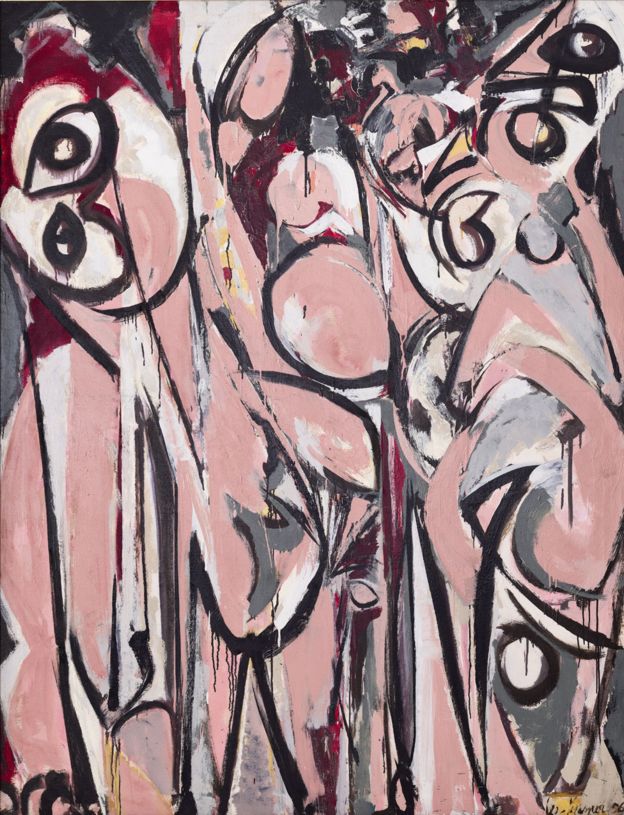
After Pollock’s death in a car crash in 1956, you can see a drastic change in her work. Her paintings from this year are more fleshy and primal – most poignantly in Three in Two (1956), where you can make out three standing fleshy pink abstracted female forms. Remniscent of Picasso‘s Les Desmoiselles d’Avignon (1907), Krasner’s distorted figures can be seen to reflect her grief. Unlike Willem De Kooning’s contemporary paintings, like Woman I (1952), these bulbous, sharp edged anthropomorphic forms do not set out to dissect and fragment the female nude but instead can be seen as Krasner’s raw release of emotion onto the canvas.
Moving downstairs to the main galleries, you are faced with more monumental sized canvasses with colourful paint mimicking the path of her body as she created these allover works. In Combat (1965), abstracted figures in hot pink dance across the horizontal canvas drawing to mind the carved processions of ancient temples. The exhibition ends with large scale paintings from her Umber series devoid of colour except for earth tones, such as Polar Stampede (1960). During this period of her life she suffered from insomnia and would paint throughout the night when she could not sleep; working with artificial light she stopped working with bright colours and moved to a more sombre palette.
What is quite interesting about the curation of the exhibition is that it is not chronological – separating the biography from her art. We can’t draw a linear path between the paintings, which is refreshing and invites reflection of her sensational technique and vision rather than her personal life, which has clouded the public’s perception of Krasner for so many years. Instead of highlighting when Pollock’s influence took hold on her style or a transitional moment in her style due to the artist, the curators have instead focussed on stylistic features and the brilliant colours and forms she produced on her canvas. Closing on the first of September, this exhibition presents a refreshing and novel perspective on the brilliant creativity that was Lee Krasner. Mrs. Pollock unveiled.
 Mala Yamey